To help us provide you with free impartial advice, we may earn a commission if you buy through links on our site. Learn more
- Fast and powerful dehumidification
- Excellent smartphone app
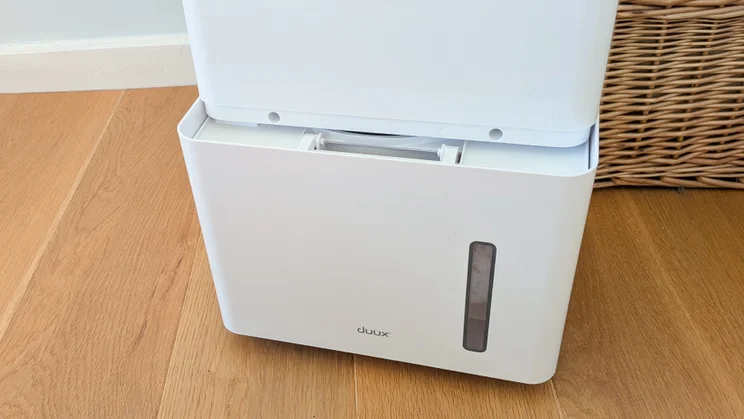
- Large and easy-to-empty water tank
- Higher noise levels than rivals
- Awkward multi-function controls
- Laundry mode may need two cycles
Duux impressed us a few years ago with its Bora 30L dehumidifier. It was compact but surprisingly powerful, with strong performance both for removing moisture from rooms and drying laundry, even if it was a little noisy while it did it.
Since then, 12Duux has refined the Bora’s design, improved its smart app and made its laundry-drying capabilities easier to use. We’ve had the 20L version in for testing, and it’s a serious rival to our current mid-sized champs, the ProBreeze OmniDry 20L and the Meaco Arete Two 20L.
Duux Bora Smart 20L: What do you get for the money?
The Duux Bora Smart 20L is a compressor dehumidifier with a 20l/day extraction rate and a 4L water tank. That’s slightly larger than the average for a 20l dehumidifier, though it’s matched by ProBreeze OmniDry 20L, while the Arete Two offers even more capacity with a 4.8l tank. It’s designed to work at temperatures above 15°C, so it’s not really suitable for colder indoor spaces or outbuildings; you might want to look into a desiccant dehumidifier for that job.
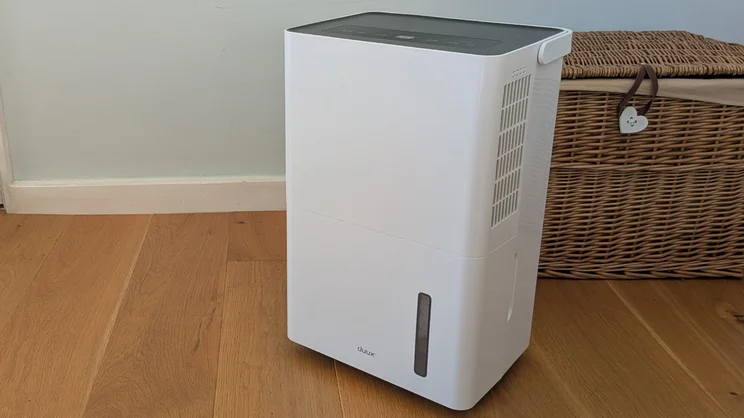
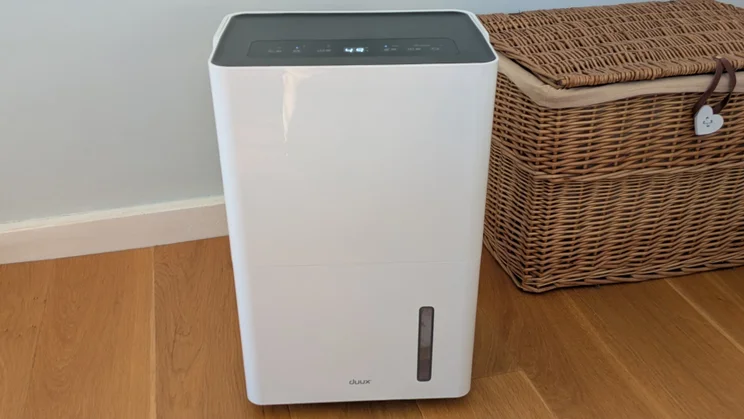
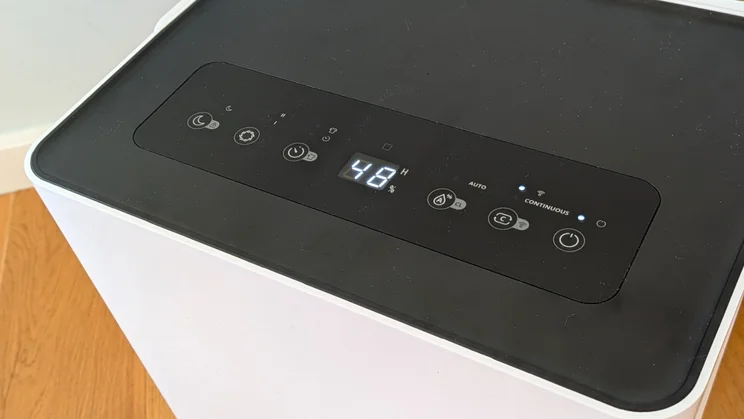
In terms of size, the Bora Smart sits somewhere between the Meaco and ProBreeze dehumidifiers: at 51cm, with a 32 x 23.5cm footprint, it’s bigger than the latter, but smaller than the former. As with the first Bora we reviewed, the design is elegant, with clean lines, gloss-white surfaces, rounded corners and premium-feeling plastics. All the controls are mounted on the top, with a digital display showing the current relative humidity. This is flanked by six membrane buttons, used to power the unit on and off, adjust the target humidity, set the timer and switch between the different modes. LED indicators also show the current mode and fan speed.
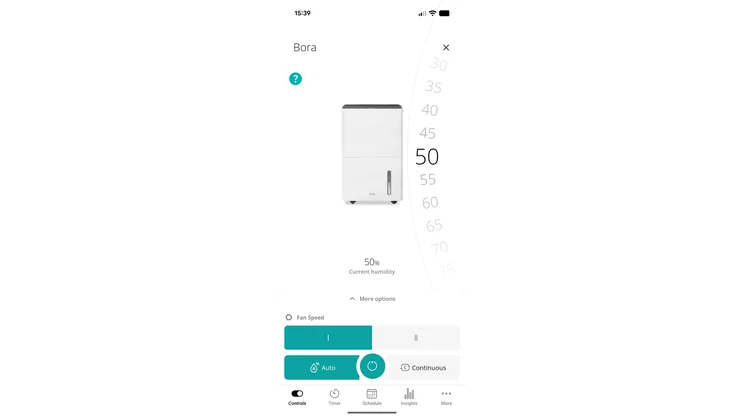
You can also run the Bora remotely using Duux’s slick and intuitive smartphone app, where on-screen buttons and adjustable wheels make it easy to control all the basic operations. You can set schedules for times and days of the week, while graphs allow you to track humidity levels over previous days, weeks or even months.
Duux throws in a carbon filter with the Bora, which fits into the intake grille at the rear, to help remove odours and airborne particulates as the dehumidifier does its work. It’s not an air purifier as such, as it’s not tracking particulate levels or adjusting the fan speed to lower them, but it’s a useful perk when you’re using the Bora regularly.
What features does it have?
The main mode here is an Auto mode, which sets the compressor and fan speed to reach your target relative humidity as quickly and efficiently as possible. This usually means running at full power while it gets the humidity under control, before tapering down to lower fan speeds and quieter running as it nears its target. A Continuous mode runs the dehumidifier at the selected fan speed until the water tank is full or it’s turned off, while a Night mode turns lights and beeps off without really affecting running speeds or noise levels.
Beyond that, you have a 24 hour on/off timer and a child lock, plus a Laundry mode that runs the dehumidifier at high speed on a four-hour timer. Finally, there’s a self-cleaning function to dry and clean the dehumidifier before you put it away in storage for the summer.
How did I test the Duux Bora Smart 20L?
I test all dehumidifiers over several days inside a three bedroom house, allowing me to make meaningful comparisons on their performance, features, energy consumption and noise. I test the 20-30L models in a large living room that’s prone to damp and mould, especially in wet winters.
I keep the room at a comfortable 19-20°C temperature while testing, and use a wireless air-quality monitor backed up by a temperature and humidity meter (hygrometer) to measure relative humidity (RH). I set the dehumidifier to run on the highest setting with a 50% RH target, and measure RH before testing, after one hour and then again after a second hour.
I also use the dehumidifier in other rooms around the house, and test any laundry drying features to judge how effectively these work. Finally, I use a smart plug with energy monitoring and a smartphone noise meter app to check power consumption and noise levels during active use.

How well does it work?
As with the Bora 30L that we reviewed before, the Bora Smart 20L is a fast and effective unit. At the start of testing, the relative humidity in the living room sat at a moist 71%, not helped by washing left drying overnight on radiators. One hour later this was down to 62%, while a further hour saw that drop to 58%. That’s not quite as good as the 30L model, but you’d expect that from a 20L dehumidifier. While direct comparisons are tricky, that performance is in the same ballpark as, if not slightly better than, the OmniDry 20L and 20L Arete Two.
On the downside, noise levels are higher. Running at full power with the fan on high, I measured the sound output from the Bora Smart 20L at around 48.7dBA. Even with the fan on low, I didn’t record anything lower than 41.4dBA. The Arete Two is significantly quieter, while the ProBreeze hovers between 36dBA on low and 44dBA on high. There’s quite a loud hum from the Bora’s compressor, and it’s not the kind of sound you can easily sleep through.
Energy efficiency is a bit more competitive, but I still measured power consumption at 244.75W with the dehumidifier running maxed out, which is a little higher than the OmniDry 20L at 226W and the Arete Two 20L at 224W. .
What could be improved?
Obviously noise output is the big thing, but I had some issues with the Bora Smart 20L’s general usability as well. Some functions, such as turning it on or emptying the water tank, are very easy, and the smartphone app is great to use. However, switching modes requires long button presses and you still have to toggle through the different target humidity settings. The physical controls could really do with a bit of an overhaul.
I’m also not completely convinced by the Laundry mode. I left the dehumidifier running with a rack full of washing and while I returned to find T-shirts and underwear dry, jeans, jumpers and sweatshirts were still a bit damp – especially where garments were folded over. I suspect the default four hours isn’t really enough, as a second cycle did the job.
Should you buy the Duux Bora Smart 20L?
Like its 30l stablemate, this is a speedy and effective dehumidifier. If you want something that acts fast to remove moisture, you should definitely have it on your shortlist, and Duux’s smartphone app is one of the best I’ve tested.
All the same, the Meaco Arete Two and the ProBreeze OmniDry 20L run quieter and are easier to use, while the latter is smaller and easier to lug around the house. The Bora Smart 20L wins on performance, but its rivals have a bit more finesse.